- Schedule Appointment
- (914) 632- 1111
- office@drcomodds.com

The industry continues to change what is possible in modern dental care through 3D printing in dentistry. At Como Dental Design in New Rochelle, I have always believed that new technology deserves a place in our practice only when it provides a meaningful benefit to our patients.
That is why I am excited to introduce our newest investment: an advanced in-office 3D dental printer.
Earlier this year, I shared some of my thoughts about modern dental technology and why I believe dentists should take a thoughtful, measured approach to innovation. New technology should never be adopted simply because it is new. It should improve our ability to diagnose, plan, treat, or care for our patients.
Our new 3D printing capabilities are another step forward in that philosophy.
For patients throughout New Rochelle and Lower Westchester, this technology gives us greater control over specific parts of the dental workflow and enables us to create highly customized dental appliances and treatment tools directly in our office.
Many of our patients have already experienced the benefits of the advanced dental technology we use at Como Dental Design.
Our technology includes digital radiographs, intraoral digital scanning, Cone Beam CT (CBCT) imaging, and digital implant planning and surgical workflows.
Together, these technologies allow us to collect detailed information about a patient’s teeth, bite, bone structure, and oral anatomy, and use it to plan treatment with a high degree of precision.
In-office 3D printing adds another important piece to that digital workflow.
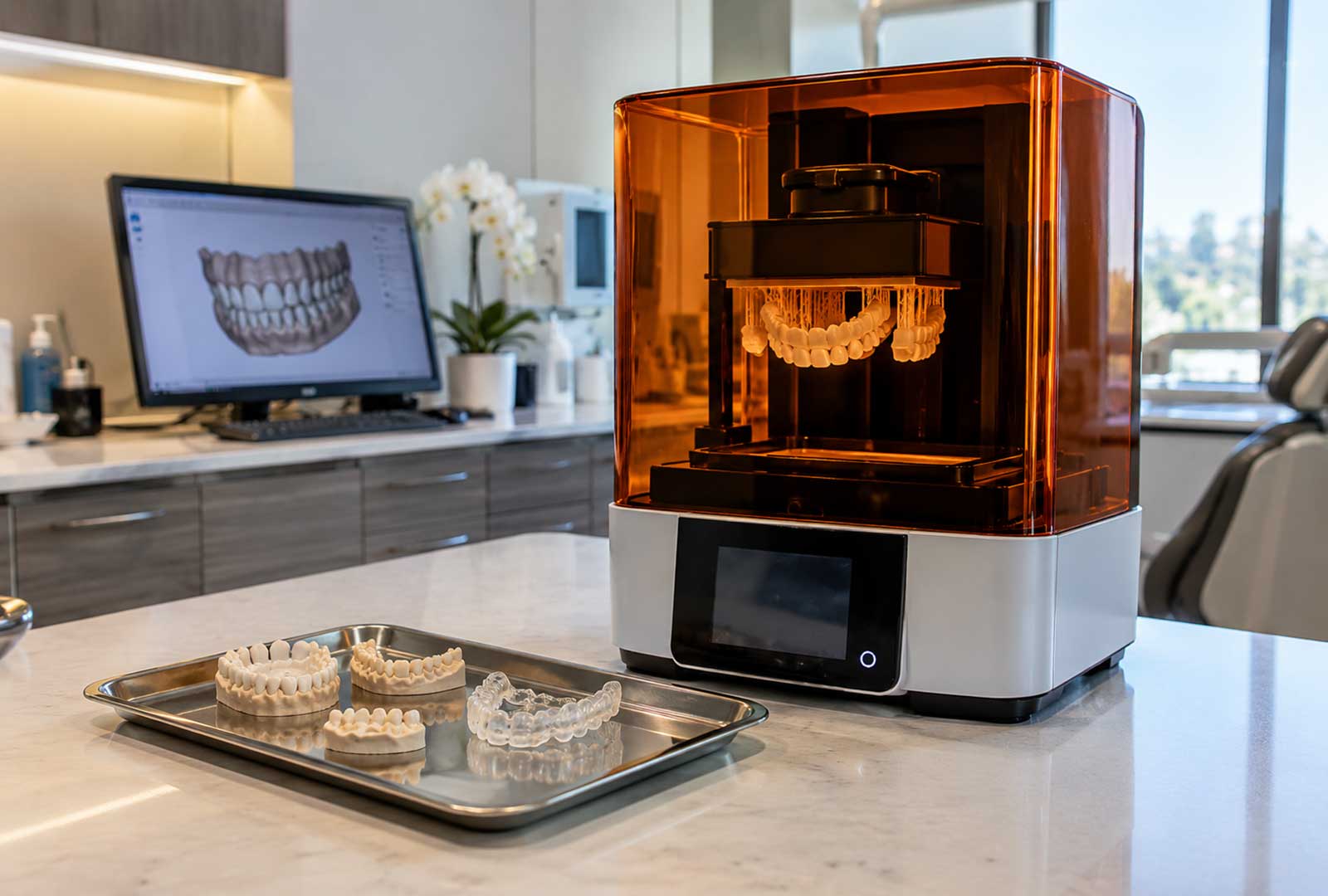
Instead of digital information ending with a scan or a computer model, we can now use it to fabricate customized dental devices directly in our office.
Many patients hear the term “3D printing” and understandably wonder how it applies to dentistry.
The process begins with digital information, such as an intraoral scan or other imaging. Specialized software allows us to use that information to design an appliance, model, restoration, or treatment guide based on the individual patient’s anatomy.
Depending on the clinical situation and the materials indicated for that particular use, dental 3D printing can help us create:
The U.S. Food and Drug Administration explains that 3D-printed medical and dental devices must be manufactured using materials and processes appropriate for their intended use. The American Dental Association also identifies applications such as surgical guides, dental models, occlusal guards, orthodontic appliances, temporary restorations, and certain definitive restorations among the uses of dental 3D printing.
Not every patient or procedure requires something that can or should be 3D printed. As with every technology in dentistry, the important question is not simply whether something can be printed, but whether using that approach is the appropriate choice for that particular patient.
One of the primary advantages of digital dentistry is precision.
When we combine detailed digital scans with treatment-planning software and in-office fabrication, we can control more of the process from beginning to end.
For example, when planning dental implant treatment, a digitally designed surgical guide can help translate the treatment plan into the clinical procedure. The guide is created based on the patient’s anatomy and the planned implant position.
This does not replace the dentist’s clinical judgment or surgical skill. It provides another tool to help the dentist implement a carefully developed treatment plan.
The same principle applies to other dental appliances. Digital designs can be reproduced with a high degree of consistency and customized specifically for the patient.
Traditionally, many dental appliances and models have been sent to an outside dental laboratory for fabrication.
Dental laboratories continue to play an extremely important role in dentistry, and there are many situations where we will continue to rely on highly skilled laboratory technicians.
However, in-office 3D printing gives us another option.
In appropriate cases, producing an item in our own office can reduce the time required to send information and materials back and forth to an outside laboratory. It also allows my team and me to maintain oversight of the design and production process.
That can mean greater efficiency, better quality control, and a more streamlined experience for our patients.
It may also help us manage certain laboratory-related costs more efficiently without compromising the quality of care.
Artificial intelligence is another rapidly developing part of digital dentistry.
AI systems can assist clinicians in analyzing information, recognizing patterns, organizing data, and improving parts of the dental workflow. I believe these tools will become increasingly useful as the technology continues to mature.
But I also believe strongly that artificial intelligence should support clinical expertise, not replace it.
I often compare this to commercial aviation. Modern airplanes have extremely sophisticated automated systems, yet passengers still want an experienced pilot in the cockpit—someone who understands the aircraft, evaluates changing conditions, and knows when human judgment is required.
Dentistry is no different.
The most advanced scanner, AI software, CBCT system, or 3D printer is only as useful as the clinician applying the information.
A computer can assist with planning. It cannot replace the trained eye that recognizes subtle clinical findings, the judgment developed over years of treating patients, or the hands-on skill required to perform complex dental procedures.
The human element remains essential.
Throughout my career, I have believed that staying current with advancements in dentistry is not optional. It is part of my responsibility to my patients.
As Program Director of the NYU College of Dentistry Continuing Dental Education Implant Program, I have the opportunity to work alongside experienced clinicians, educators, industry leaders, and dental professionals who continually evaluate new techniques and technologies.
That exposure allows me to look at emerging technology from both academic and private-practice perspectives.
I want to understand not merely what a technology can do, but whether it can meaningfully improve patient outcomes, comfort, efficiency, treatment planning, or long-term oral health.
That is the standard we use when deciding what belongs at Como Dental Design.
The future of dentistry will undoubtedly include more digital technology, artificial intelligence, advanced imaging, and in-office manufacturing.
But I do not believe the future is about replacing dentists with machines.
It is about giving experienced dentists better tools.
Our new in-office 3D printer reflects that philosophy. When combined with digital scanning, CBCT imaging, careful treatment planning, and clinical experience, it provides us with another way to deliver precise, highly personalized care.
These technologies can be especially valuable when planning dental implant procedures and other complex restorative dental treatments that require careful coordination between diagnosis, planning, and treatment.
For patients in New Rochelle, Pelham, Larchmont, Mamaroneck, and throughout Lower Westchester, our goal remains exactly what it has always been: to combine modern dentistry with experience, judgment, personal attention, and a relationship built on trust.
If you are interested in learning how our digital technology may be used as part of your care, I welcome you to schedule an appointment with Como Dental Design.
Depending on the printer, materials, and clinical application, dental 3D printing can be used to create surgical guides, dental models, night guards, retainers, whitening trays, temporary restorations, and certain permanent dental restorations.
3D printing can be used to fabricate customized surgical guides based on digital implant planning. These guides can help the dentist translate the planned implant position into the surgical procedure. The appropriate approach depends on the individual patient’s anatomy and treatment needs.
It can make certain parts of treatment more efficient because some appliances or treatment devices can be designed and fabricated without being sent to an outside laboratory. The amount of time saved varies depending on the procedure.
No. It is another tool within the dental workflow. Clinical judgment remains the responsibility of the dentist, and skilled dental laboratories continue to be important partners for many types of restorative and prosthetic treatment.